News Team Research Publications Teaching Software & Tools Join Us Contact

Texas State University · Mechanical Engineering

Design Integration &
Systems Optimization Lab

Our mission is to advance the design, integration, and optimization of engineering systems through physics-based and data-driven modeling, systems co-design, intelligent decision-making, and interdisciplinary innovation.


"Knowing is not enough; we must apply. Being willing is not enough; we must do." — Leonardo da Vinci (1452–1519)
DISO Lab logo
We are currently hiring graduate students in the Ingram School of Engineering at Texas State University!

Latest updates

News

08 / 2026

Welcome Md Muhtasim Fuad to the DISO Lab!

We are excited to welcome Md Muhtasim Fuad to the Design Integration and Systems Optimization (DISO) Lab! Fuad joined the lab in August 2026 as a Ph.D. student in the Mechanical and Manufacturing Engineering program at Texas State University. For more his info, please see his profile page.

Welcome to the DISO Lab, Fuad!

08 / 2026

Welcome Tanvir Ahmed to the DISO Lab!

We are excited to welcome Tanvir Ahmed to the Design Integration and Systems Optimization (DISO) Lab! Tanvir joined the lab in August 2026 as a Ph.D. student in the Mechanical and Manufacturing Engineering program at Texas State University. For more his info, please see his profile page.

Welcome to the DISO Lab, Tanvir!

08 / 2026

Welcome Dr. Ying-Kuan (Rick) Tsai joins Texas State University and launches the Design Integration and Systems Optimization (DISO) Lab.

Dr. Ying-Kuan (Rick) Tsai has officially joined the Ingram School of Engineering at Texas State University as an Assistant Professor of Mechanical Engineering and launched the Design Integration and Systems Optimization (DISO) Lab.

06 / 2026

Presented our latest work on Bayesian co-design for AM at NAMRC54, State College, PA, USA.

Dr. Tsai presented the paper "UNiCO-AM: Uncertainty-aware Neural Co-design for Additive Manufacturing via an Attention-based Spatio-Temporal Neural Operator and Bayesian Optimization" at the North American Manufacturing Research Conference (NAMRC) 54. This work introduces a co-design framework for additive manufacturing that jointly optimizes material properties and process parameters under uncertainty.

08 / 2025

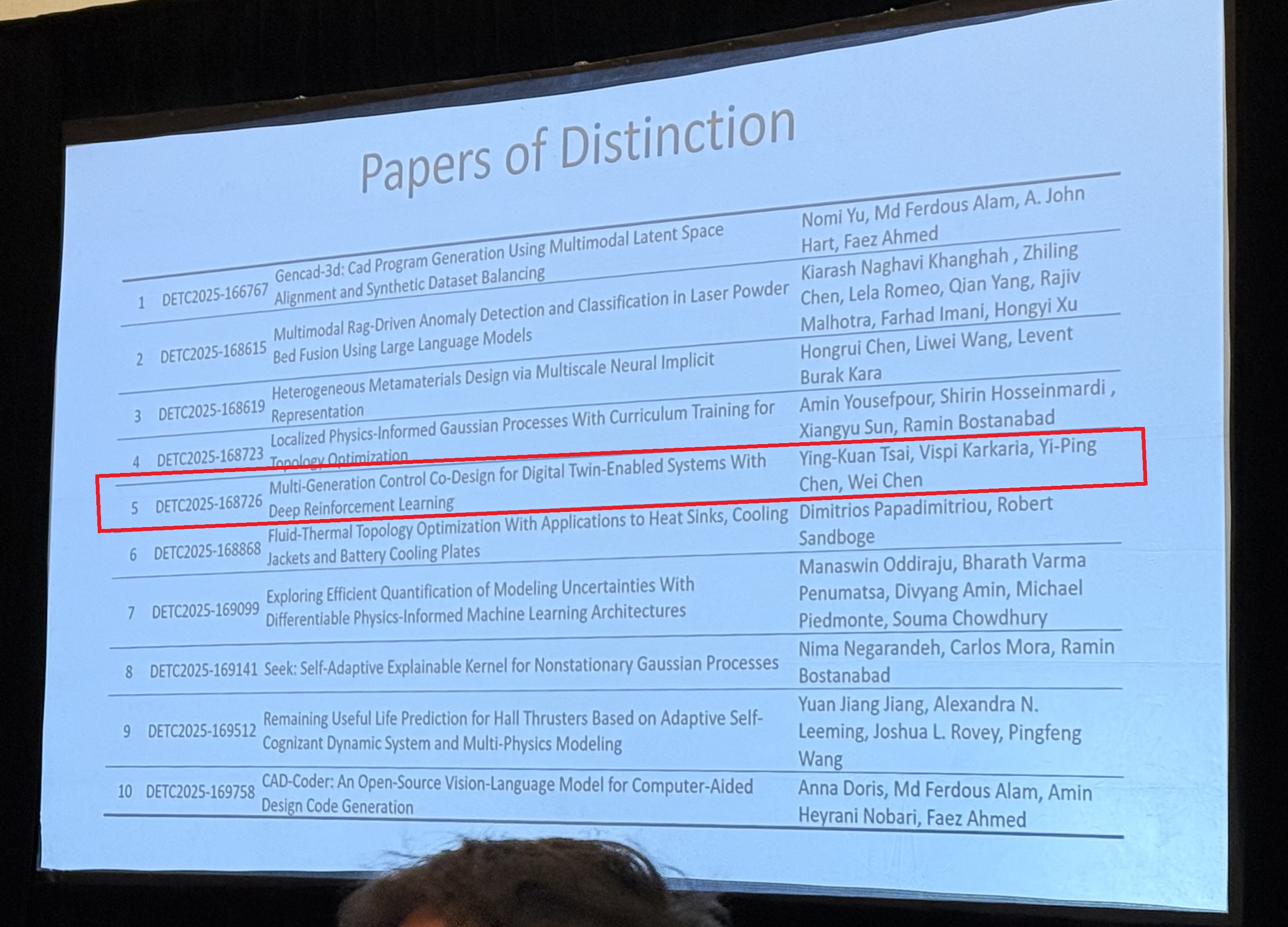
Received the "Paper of Distinction" at ASME IDETC-CIE Design Automation Conference (DAC).

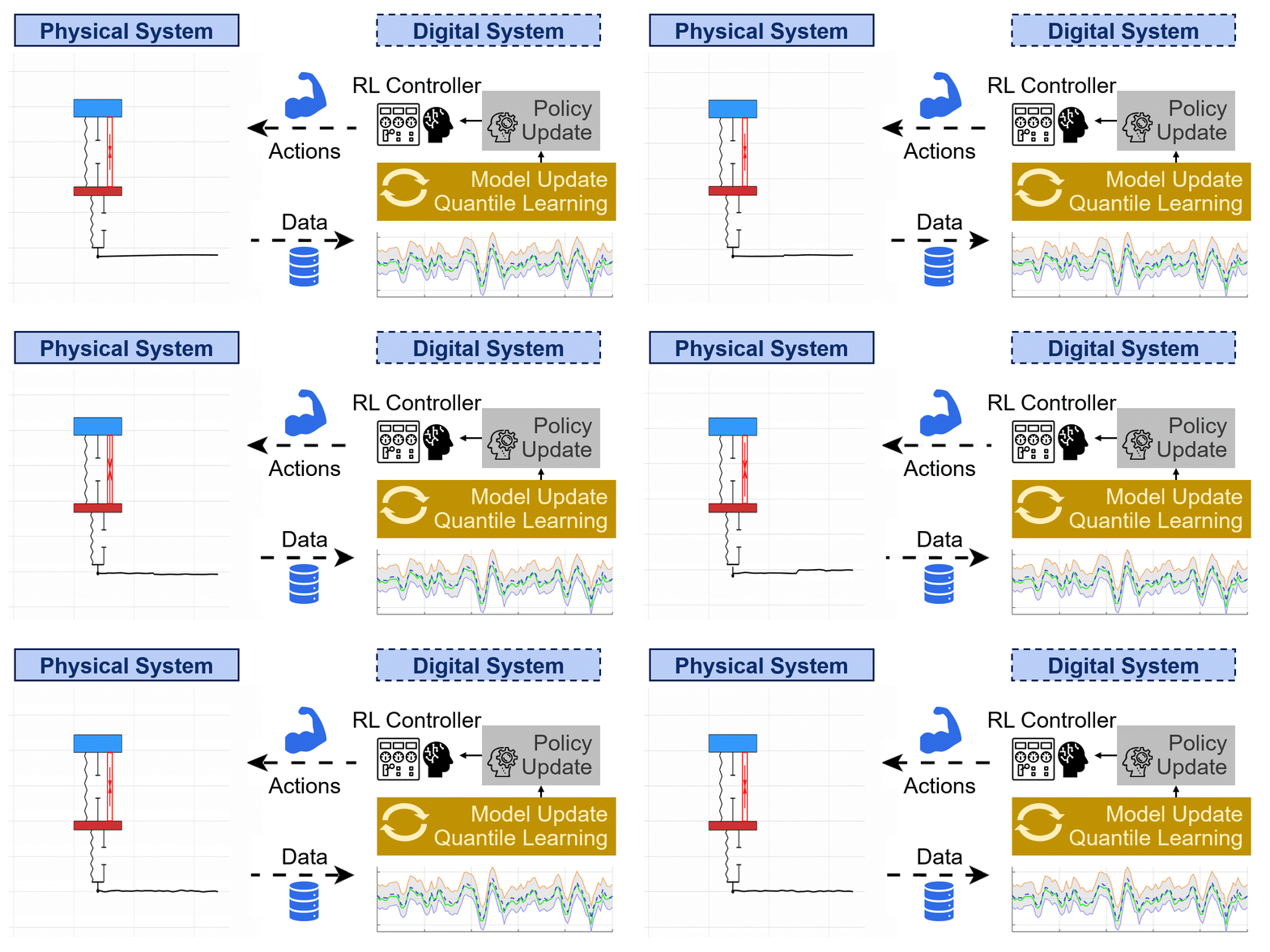
Top 10 papers selected from 101 accepted papers by the Design Automation Conference (DAC) committee. The recognized paper is "Multi-generational Control Co-Design for Digital Twin-enabled Systems with Deep Reinforcement Learning." Paper of Distinction at ASME IDETC-CIE DAC 2025

06 / 2025

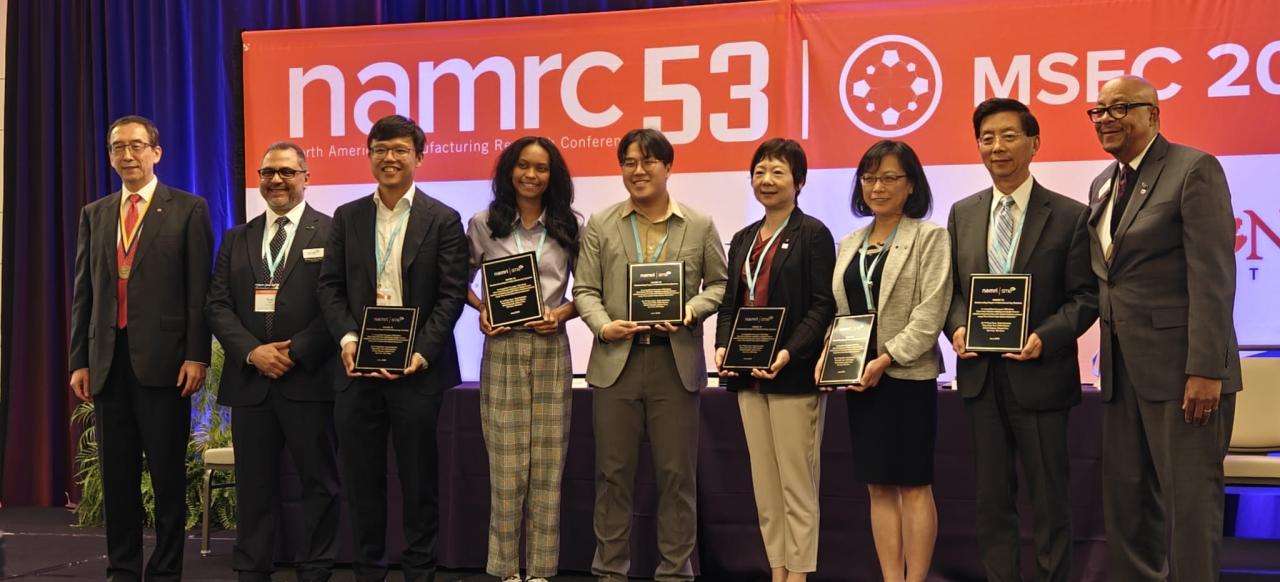
Received the "Outstanding Paper Award" in the Manufacturing Systems Track at North American Manufacturing Research Conference (NAMRC) 53.

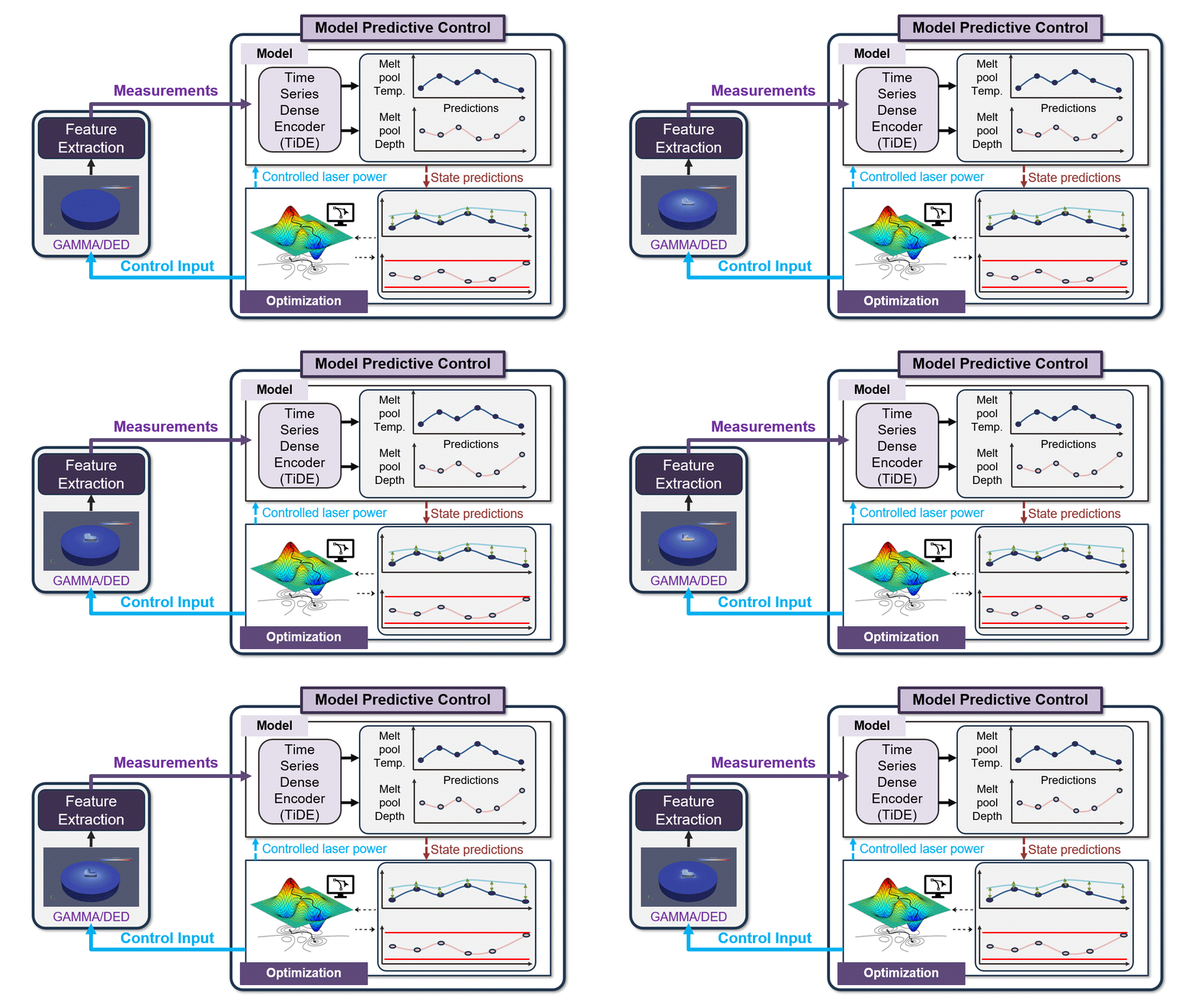
Top 2 papers selected from 269 accepted papers by the conference committee. The recognized paper is "Real-Time Decision-Making for Digital Twin in Additive Manufacturing with Model Predictive Control using Time-Series Deep Neural Networks." Outstanding Paper Award at NAMRC 53

The people

Our Team

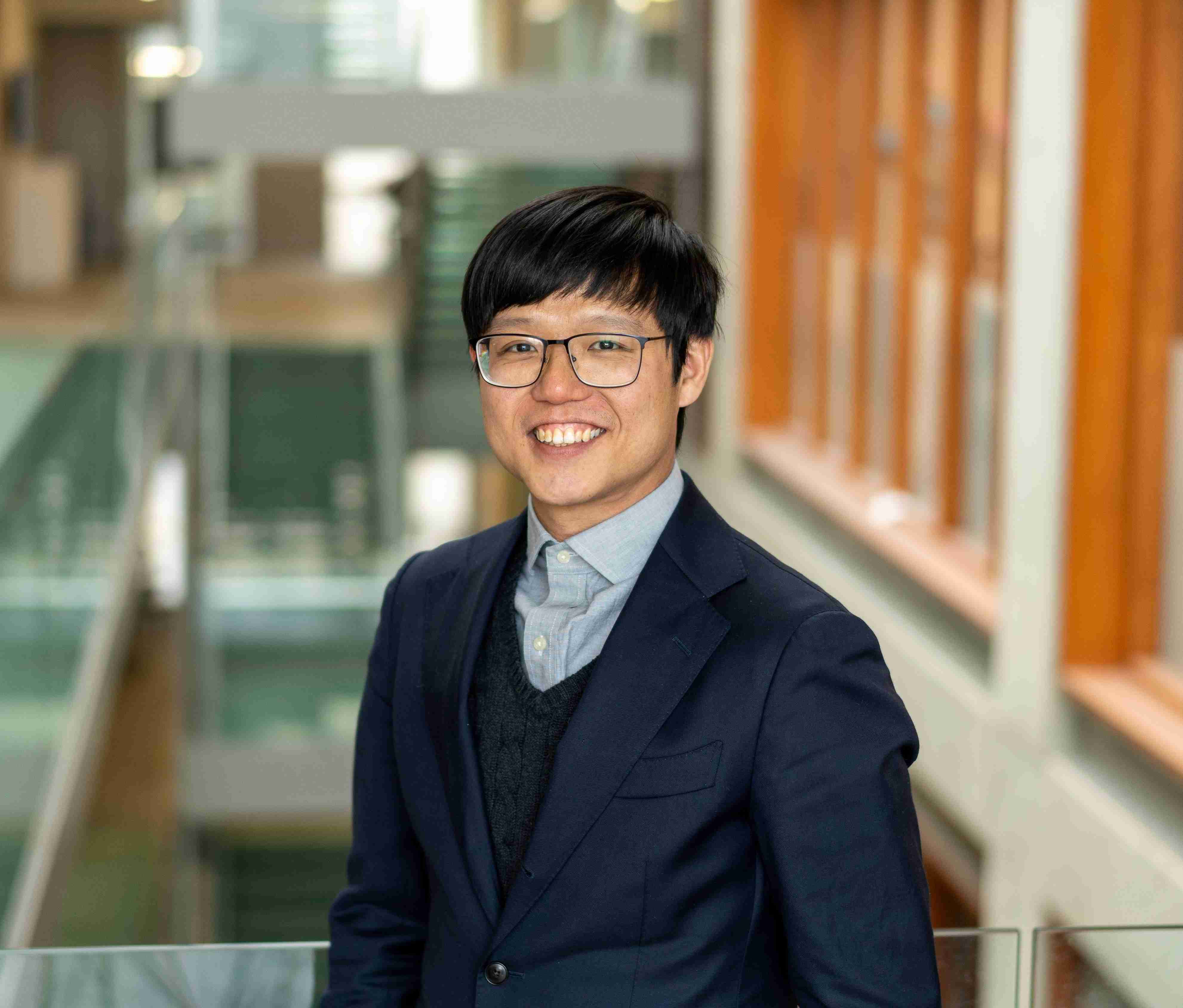
Dr. Ying-Kuan (Rick) Tsai

Dr. Ying-Kuan (Rick) Tsai

Principal Investigator

Dr. Tsai's research focuses on optimizing dynamic engineering systems, with an emphasis on integrating AI/ML, optimization, modern control, and digital twins. He has published over 20 peer-reviewed papers in the fields of engineering design, optimization, manufacturing, control, and digital twins.

Professional History
- Assistant Professor, Mechanical Engineering, Texas State University, San Marcos, TX, USA (2026–)
- Postdoctoral Scholar, Mechanical Engineering, Northwestern University, Evanston, IL, USA (2024–2026)

Education
- Ph.D. in Mechanical Engineering, Texas A&M University, College Station, TX, USA (2023)
- M.S. in Mechanical Engineering, National Taiwan University, Taipei, Taiwan (2018)
- B.S. in Mechanical Engineering, National Taiwan University of Science and Technology, Taipei, Taiwan (2016)

Teaching Interests: Design Optimization, Digital Twins, Dynamics and Control, and Numerical Methods
Tanvir Ahmed

Tanvir Ahmed

Ph.D. Student

Education
- Ph.D. in Mechanical and Manufacturing Engineering, Texas State University, San Marcos, TX, USA (Fall 2025 – Present)
- M.S. in Mechanical and Manufacturing Engineering (2025), Texas State University, San Marcos, TX, USA.

Research Interests: Reinforcement learning-based control co-design, digital twins, embedded sensing and machine learning for physical systems, autonomous and robotic systems, SLAM & Navigation.

MF

Md Muhtasim Fuad

Ph.D. Student

Education
- Ph.D. in Mechanical and Manufacturing Engineering, Texas State University, San Marcos, TX, USA (Fall 2025 – Present)
- M.S. in Engineering (Major: Mechanical and Manufacturing Engineering), Texas State University, San Marcos, TX, USA (Spring 2024)

Research Interests: Active learning, Bayesian optimization, Gaussian processes, multi-fidelity modeling, surrogate modeling, data-driven optimization, and design of experiments.

+

We're hiring

PhD · Master

We welcome applications from candidates with backgrounds in control, design optimization, machine learning, or engineering science.

What we study

Research Areas

We develop fundamental frameworks for optimizing dynamic engineering systems through the integration of artificial intelligence and machine learning (AI/ML), optimization, modern control, co-design, and digital twin technologies. We are building intelligent and adaptable systems that continuously learn from real-world data under uncertainty and evolve over their operational lifecycle with applications to autonomous systems across robotics, advanced manufacturing, automotive, smart materials, and aerospace domains.

AI-Enabled Digital Twins for Real-Time Decision-Making

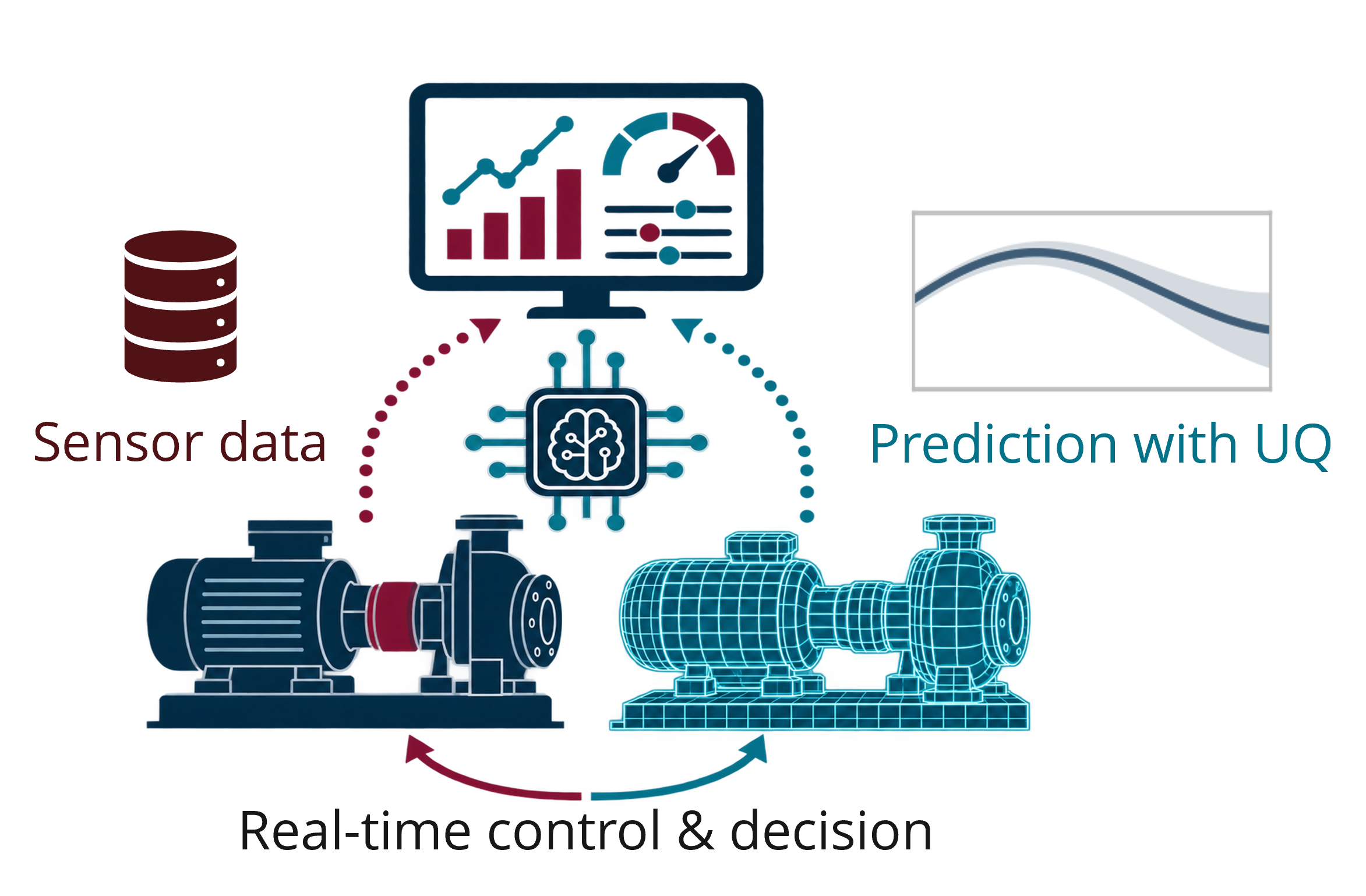
We develop digital twin frameworks that fuse physics-based models with ML to enable real-time monitoring, control, and uncertainty-aware decision-making throughout a system's lifecycle.

Learn more →
Digital twin loop: sensor data from a physical pump feeds an AI model and its digital twin, producing predictions with uncertainty quantification for real-time control and decision-making

Control Co-Design for Intelligent Autonomous Systems

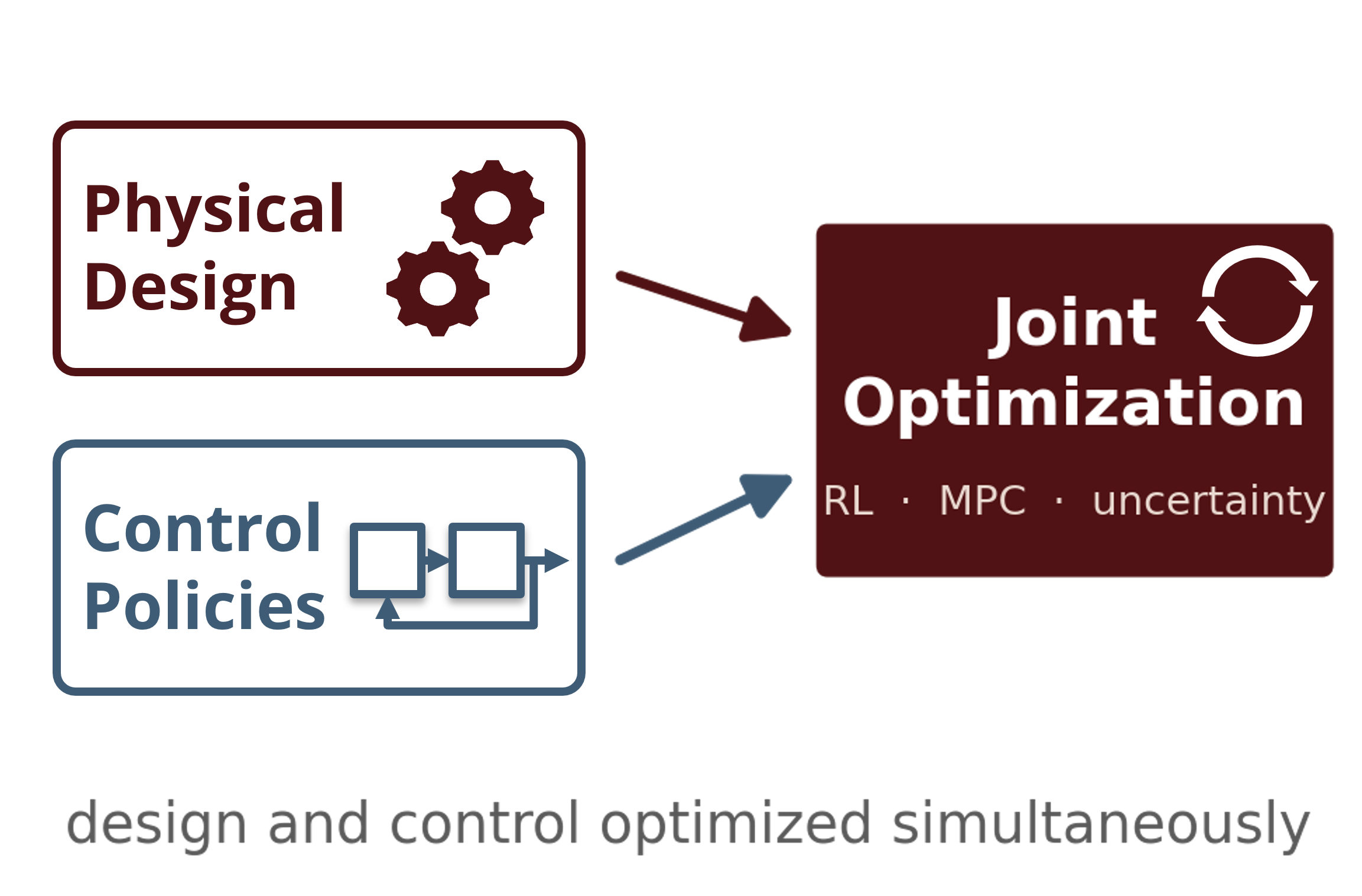
We advance CCD methodologies that integrate reinforcement learning (RL) and model predictive control (MPC) to jointly optimize physical design and control policies for autonomous systems operating in dynamic and uncertain environments.

Learn more →
Control co-design: physical design and control policies feed a joint optimization using RL, MPC, and uncertainty

Active Learning and Optimization under Uncertainty

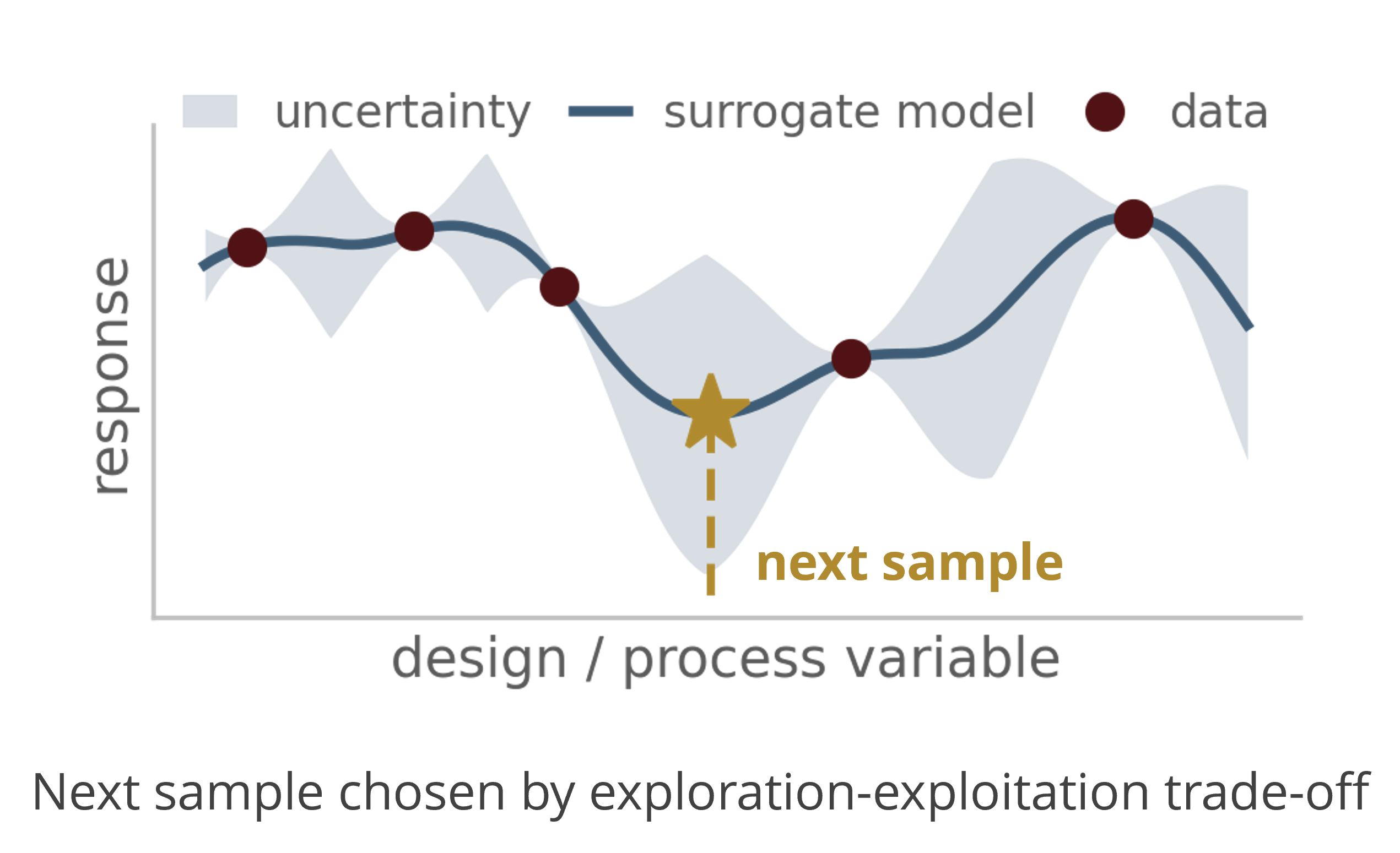
We develop active learning and advanced optimization methods that scale to system-level digital twins with inherent noise for data-efficient and interpretable decision-making across large-scale engineering systems.

Learn more →
Active learning: a surrogate model with uncertainty band fitted to data, with the next sample chosen by an exploration-exploitation trade-off

Our work

Key Publications

A few highlights of our recent work. See all publications for the full list, or visit my Google Scholar.

Google Scholar
Digital Twin CCD RL animation
CCD 2026

Digital Twin-Enabled Multi-Generation Control Co-Design with Deep Reinforcement Learning

Ying-Kuan Tsai, Vispi Karkaria, Yi-Ping Chen, Wei Chen

Journal of Mechanical Design · July 2026

(DAC Paper of Distinction at IDETC2025)

Full vehicle active suspension system
Digital Twin 2026

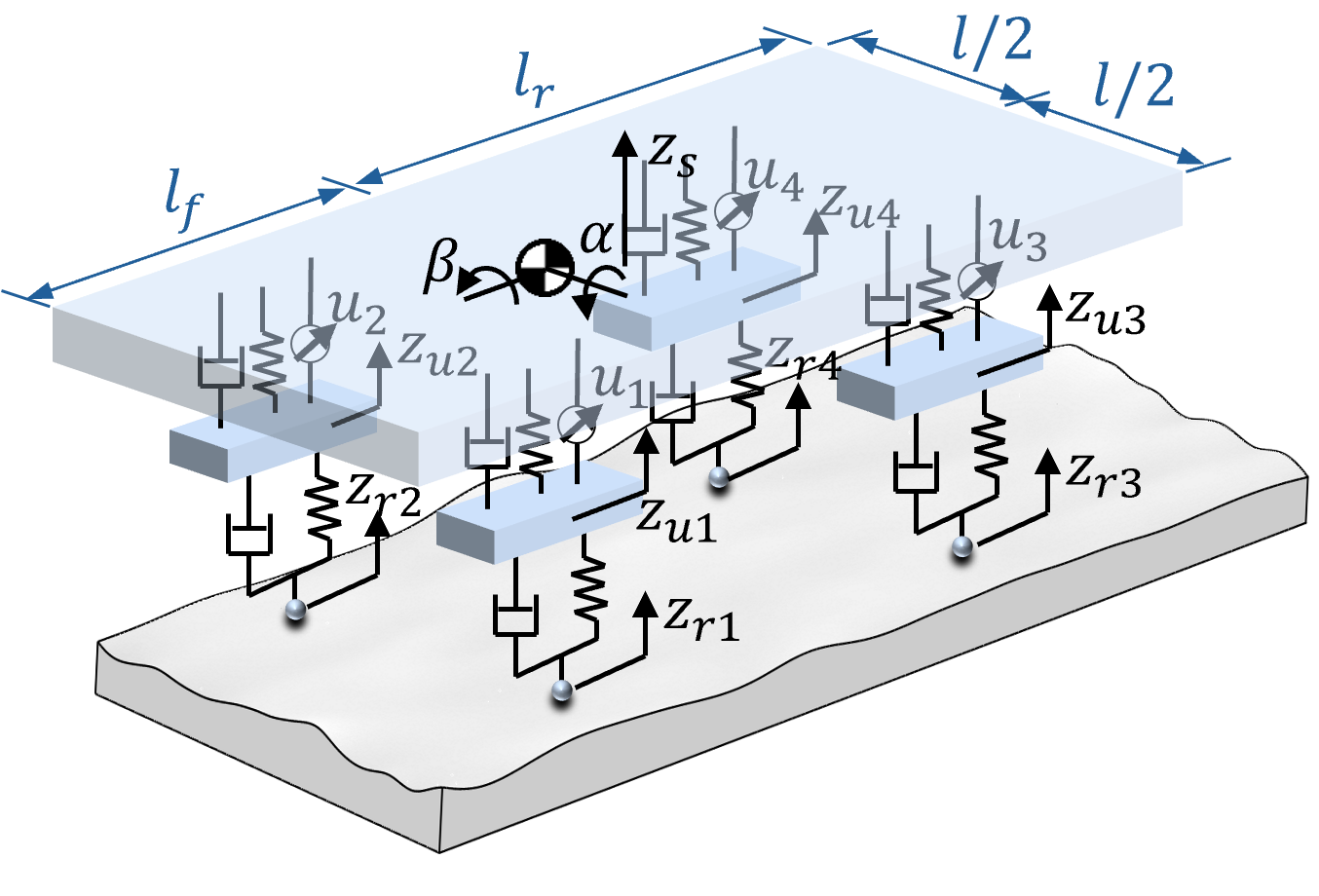
Reinforcement Learning-Based Control Co-Design of Digital Twin-Enabled Full-Vehicle Active Suspension Systems

Ying-Kuan Tsai, Yi-Ping Chen, Vispi Karkaria, Wei Chen

Structural and Multidisciplinary Optimization (Special Issue on Reduced Order Modeling, Generative AI, and SciML in Digital Twins) · April 2026

MPC additive manufacturing animation
Digital Twin 2025

Real-Time Decision-Making for Digital Twin in Additive Manufacturing with Model Predictive Control Using Time-Series Deep Neural Networks

Yi-Ping Chen, Vispi Karkaria, Ying-Kuan Tsai, Faith Rolark, Daniel Quispe, Robert X Gao, Jian Cao, Wei Chen

Journal of Manufacturing Systems · August 2025

(Manufacturing Systems Outstanding Paper at NAMRC53 in 2025)

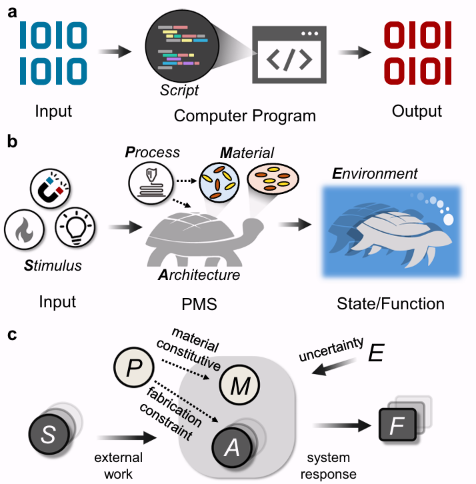
Co-design framework for programmable material systems
Optimization 2026

Co-Design of Programmable Material Systems

Dex Doksoo Lee, Liwei Wang, Bolin Chen, Ying-Kuan Tsai, Jay Sim, Ruike Renee Zhao, Xiaojia Shelly Zhang, Wei Chen

npj Metamaterials · September 2026

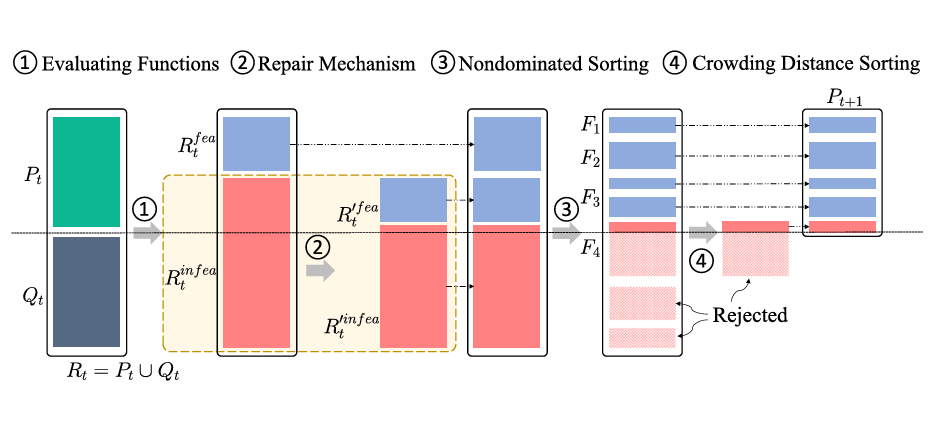
Bayesian constraint-handling technique for parametric optimization
Optimization 2024

Surrogate‑Assisted Constraint‑Handling Technique for Parametric Multi‑Objective Optimization

Ying-Kuan Tsai, Richard J Malak

Structural and Multidisciplinary Optimization · September 2024

In the classroom

Teaching

Teaching Philosophy

Even in an era of powerful simulation tools and AI, I believe that a strong foundation in engineering fundamentals remains essential—not just to solve problems, but to critically evaluate results, understand the underlying physics, and explain why an answer makes sense.

Teaching Interests

  • Dynamics and Controls
  • Design Optimization
  • Digital Twins
  • Numerical Methods
  • Machine Learning and Artificial Intelligence for Engineers
  • Optimal Control

Open for everyone

Software & Tools

Software and computational tools developed in the DISO Lab, free for anyone to use in research and teaching.

Web App ME 4351 · Fall 2026

Satellite Attitude Control: P / PI / PD / PID

Interactive simulator · Runs in your browser

An interactive tool for exploring feedback control of a 3-DoF linearized satellite attitude model (roll–yaw dynamics from Tsai & Malak, ASME LDSC 2025, with an added pitch axis). Developed for ME 4351 Control Systems at Texas State University.

  • Features: tune P, PI, PD, and PID gains and see the attitude response, control inputs, closed-loop eigenvalues of A + BK, transfer function T(s) with its Routh array, and a 3-D animation of the satellite.
  • Requirements: none. Everything runs directly in your web browser.

Join the lab

Openings

We are actively recruiting motivated researchers at multiple levels. If our work excites you, we'd love to hear from you.

PhD

Prospective Ph.D. Students

The Design Integration and Systems Optimization (DISO) Lab is seeking highly motivated Ph.D. students interested in developing fundamental methodologies for the design, control, and optimization of dynamic engineering systems. Our research integrates artificial intelligence and machine learning, optimization, control co-design, modern control, and digital twins, with applications in robotics, advanced manufacturing, automotive systems, smart materials, and aerospace systems.

Students with backgrounds in mechanical engineering, aerospace engineering, robotics, control systems, computer science, applied mathematics, or related fields are encouraged to apply. We value curiosity, creativity, initiative, and a passion for interdisciplinary research.

UG & MS

Undergraduate and Master's Students

Undergraduate and M.S. students at Texas State University who are interested in gaining research experience in AI/ML, optimization, control, digital twins, robotics, manufacturing, autonomous systems, or related areas are encouraged to contact Dr. Tsai.

Please email your resume and a brief description of your interests and research goals. Opportunities may include independent research projects, undergraduate research experiences, and master's thesis or project supervision.

Email Dr. Tsai →

Get in touch

Contact Us

We're always open to collaboration, media inquiries, and prospective student applications.

Location Ingram Hall, Room 4309
601 University Drive
San Marcos, TX 78666
Office hours Mon & Wed 2–4 pm ET